.png)
Here's a number that should make every marketing leader uncomfortable.
There are now 15,384 marketing technology solutions on the market. Marketing teams use just 33% of the capabilities they've already paid for.
Let me make that concrete. If your team has invested in a stack of tools, two-thirds of what you're paying for is sitting idle. And that's not a new problem, it's getting worse. Utilisation was 58% in 2020. It dropped to 42% in 2022. By 2023, it fell to 33%. Gartner's 2025 survey shows a slight recovery to 49%, but the trajectory is clear: we've been buying more and using less for five consecutive years.
Meanwhile, martech now accounts for nearly 22% of total marketing spend, making it the single largest line item in most marketing budgets. The average enterprise runs approximately 897 apps. Two-thirds of marketing teams juggle 16 or more martech tools. And 95% of IT leaders say integration is a hurdle to effective AI deployment.
We don't have a tool problem. We have an architecture problem. And the distinction between the two is, I'd argue, the most consequential strategic decision a marketing leader can make right now.
The Collection Trap
Here's how most teams end up where they are.
A new challenge appears. A new tool promises to solve it. Someone runs a trial. It works well enough in isolation. It gets added to the stack. Six months later, another challenge, another tool, another addition. Multiply this across content, SEO, social, email, analytics, CRM, advertising, and now AI, and you end up with a collection that nobody designed, nobody fully understands, and nobody can prove is generating return.
The research has a name for this. It's called tool sprawl.
And AI has made it dramatically worse. In the 2025 ChiefMartec landscape, 77% of new tools added were AI-native. Three out of every four new entrants. The barrier to building software has dropped, which means the rate of new tools entering the market has accelerated, which means the pressure on teams to evaluate, trial, and adopt has intensified, at exactly the moment when budgets and headcount are shrinking.
MarTech's analysis puts it bluntly: AI is quietly recreating the same fragmentation that enterprise consolidation was supposed to fix, just at lower cost and higher speed. Each team solves its immediate bottleneck with a locally rational decision. But globally, the stack becomes disconnected. Multiple intake paths. Conflicting status definitions. Overlapping approval flows. Dashboards that stop being trusted because they're no longer the single source of truth.
One SmartBrief analysis captured it perfectly: adding AI to a broken process doesn't make it efficient. It makes the chaos happen faster.
The Quiet Cost Nobody's Measuring
Tool sprawl isn't just an operational annoyance. It's a financial drain that most teams significantly underestimate.
Gartner warns that over 40% of agentic AI projects will be scrapped by 2027 because they were overhyped or delivered minimal business value. Only 15% of organisations qualify as high performers in Gartner's martech framework, those that meet strategic goals and demonstrate positive ROI. The remaining 85% are spending against a portfolio of platforms they cannot fully activate.
One analysis estimated that martech underutilisation could cost a company with $250 million in revenue approximately $4 million. That's not a rounding error. That's headcount. That's campaigns. That's investment in the things that actually move the needle.
And then there's the hidden cost that's even harder to quantify: decision debt. When reporting arrives too late to influence action, teams are forced to optimise reactively instead of proactively. When data lives in different systems with different definitions, confidence in any single number erodes. When marketing and finance can't agree on what a metric means, trust between CMOs and CFOs, already fragile, weakens further.
Research shows that 70% of marketers say it's harder than ever to identify audiences across touchpoints. Only 31% are satisfied with their ability to unify customer data. And 48% of sales respondents say data silos are responsible for lost revenue opportunities.
The tools aren't the problem. The fact that the tools don't talk to each other, in any coherent way, is the problem.
A Tool Collection vs. A System: Knowing the Difference
Here's the simplest diagnostic I can offer.
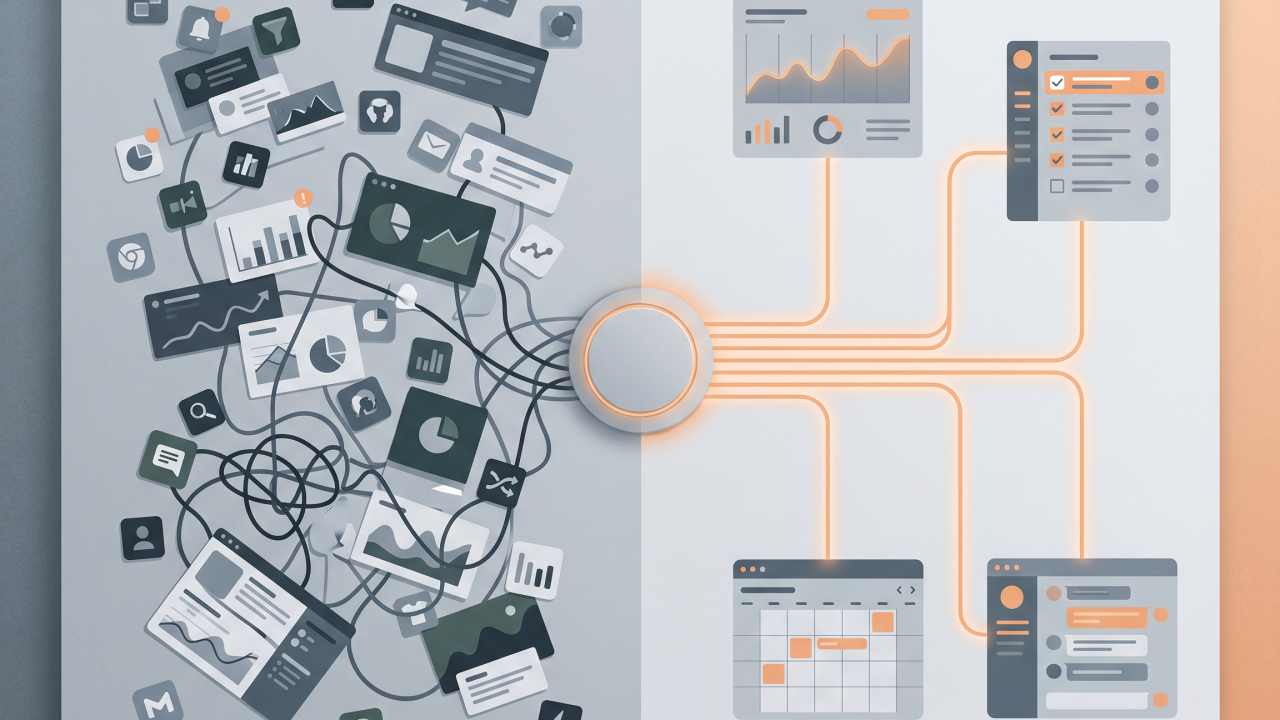
A tool collection is defined by what each product does in isolation. A system is defined by how the components work together toward a shared outcome.
In a tool collection, your CRM holds contact data, your MAP sends emails, your analytics platform reports traffic, your AI tool generates content, and your attribution model guesses which channel gets credit. Each does its job. None of them compounds the value of the others. Insights generated in one system require manual work to become actions in another.
In a system, data flows from a unified core, typically your CRM or CDP, through to execution, and back into measurement. AI doesn't sit as a separate layer. It's embedded into workflows where it can access the data it needs and feed its outputs directly into the tools that act on them. Measurement isn't a reporting function. It's a feedback loop that continuously informs strategy.
The distinction sounds abstract until you see the consequences. In a tool collection, your AI personalisation engine makes recommendations based on incomplete data because it can't access your CRM segments. Your content team creates assets that marketing automation can't properly track. Your attribution model contradicts your analytics platform because they define conversions differently. And your executive dashboard shows numbers that nobody fully trusts.
In a system, those problems don't exist, not because you bought better tools, but because you designed the connections between them.
What an Intentional AI Marketing System Looks Like
The highest-performing marketing teams in 2026 aren't distinguished by which tools they've chosen. They're distinguished by the architecture they've built beneath those tools.
Based on the research, five structural principles separate the teams producing real returns from those producing impressive tool counts.
First: A single data core, not distributed data ponds. The most effective stacks are organised around one authoritative data layer, whether that's a CDP, a data warehouse, or a CRM, that every other tool connects to rather than to each other ad hoc. This eliminates the most common source of fragmentation: different tools holding different versions of the same customer. First-party data is now the centre of gravity. 84% of marketers say they use first-party data in their programmes, while reliance on third-party data has fallen from 75% in 2022 to 61% in 2024. The teams getting this right aren't just collecting first-party data. They're making it the foundation every tool reads from and writes to.
Second: AI embedded in workflows, not bolted on top. The distinction between AI as a feature and AI as infrastructure is critical. When AI sits as a standalone tool, a separate content generator, a separate analytics summariser, a separate chatbot, it adds capability without adding coherence. When AI is embedded into your core platforms, it compounds. It can personalise journeys based on real behavioural data. It can optimise spend based on actual attribution signals. It can surface insights that flow directly into action. The teams seeing the highest ROI from AI aren't the ones using the most AI tools. They're the ones using AI within the fewest, most integrated platforms.
Third: Governance before deployment. This was a finding in every major piece of research I reviewed. Only one in four marketing teams has a written AI roadmap. Even fewer have usage policies. Without governance, every team member makes independent decisions about what to feed into AI systems, what to publish from them, and how to evaluate whether they're working. That autonomy feels productive. It's actually compounding risk, brand voice drift, data leakage, inconsistent quality, and unmeasurable outputs. The 15% of organisations Gartner classifies as high performers all share one trait: they templatise operations for easier deployment and governance. Not less creativity. More structure around how creativity gets executed.
Fourth: Consolidation as strategy, not just cost-cutting. The instinct to consolidate often comes from a finance mandate to reduce spend. That's the wrong starting point. Strategic consolidation means asking: which capabilities overlap? Which integrations are creating manual workarounds? Which tools would compound each other's value if they were properly connected? And which tools are solving problems we don't actually have? Gartner warns that removing tools without redesigning execution models preserves inefficiency in a smaller stack. Consolidation without architecture is just a cheaper version of the same mess.
Fifth: Measurement designed into the system, not layered on after. Most marketing measurement is an afterthought, a reporting layer applied on top of execution tools that weren't designed to be measured together. The result is dashboard theatre: impressive-looking data that doesn't actually tell you what's working or why. In a well-designed system, measurement is structural. Every campaign has a defined outcome before it launches. Every tool generates data that flows into a unified measurement framework. And the feedback loop between “what happened” and “what we do next” is measured in hours, not quarters.
The Real Competitive Advantage
Here's what I think is the most important insight in all of this research.
By 2026, access to AI tools is universal. There is no competitive advantage in having AI. Every competitor has it. Every vendor offers it. Every team is using it.
The advantage has shifted entirely to architecture, how your tools connect, how your data flows, how your AI capabilities compound rather than fragment, and how your measurement actually informs decisions.
The organisations that will pull ahead are not the ones with the biggest stack. They're the ones with the most coherent system. They'll spend less on tools and get more from them. They'll move faster because their data is unified, not because their team is overworked. And they'll prove ROI because their measurement was designed into the system from the start, not bolted on when the CFO asked for numbers.
Marketing leaders plan to more than double the share of marketing work powered by AI over the next three years, from roughly 17% to 44%. That's not a future prediction. That's the plan already in motion. The question is whether that doubling happens on top of a coherent system or on top of an ever-growing collection of disconnected point solutions.
The Question I'd Leave You With
If you audit your current marketing technology stack, every tool, every integration, every data flow, could you draw it as a system on a single page? Could you trace how a customer insight in one tool becomes an action in another and a measurable outcome in a third?
If you can, you're in the top 15% of marketing organisations. The ones Gartner calls high performers. The ones who meet their strategic goals and demonstrate positive ROI.
If you can't, if the honest answer is that your stack is a collection of good tools that don't compound each other's value, then the most important work on your desk right now isn't evaluating new AI tools. It's designing the architecture that makes the ones you already have actually work together.
Fewer tools. Better connections. Clearer outcomes.
That's not a downgrade. That's a system. And a system is the only thing that scales.
Marketing that thinks. Not marketing that trends.
Sources: ChiefMartec / MartechTribe 2025 Marketing Technology Landscape; Gartner (2025 and 2023 Marketing Technology Surveys, 2025 CMO Spend Survey, agentic AI warning); MarTech.org (April 2026); SmartBrief (March 2026); Heinz Marketing (January 2026); marktgAI (March 2026); Velocity Engine (April 2026); The Gutenberg (February 2026); PrimeOne Global (March 2026); AI Digital MarTech Complete Guide 2026; 2X Marketing underutilisation cost analysis; Snowflake (January 2026); Factors.ai (January 2026); Salesforce State of Sales 7th Edition; BCG 2024 AI Leaders Report.