.png)
Let me start with a number that should fundamentally change how every marketing leader thinks about their content strategy.
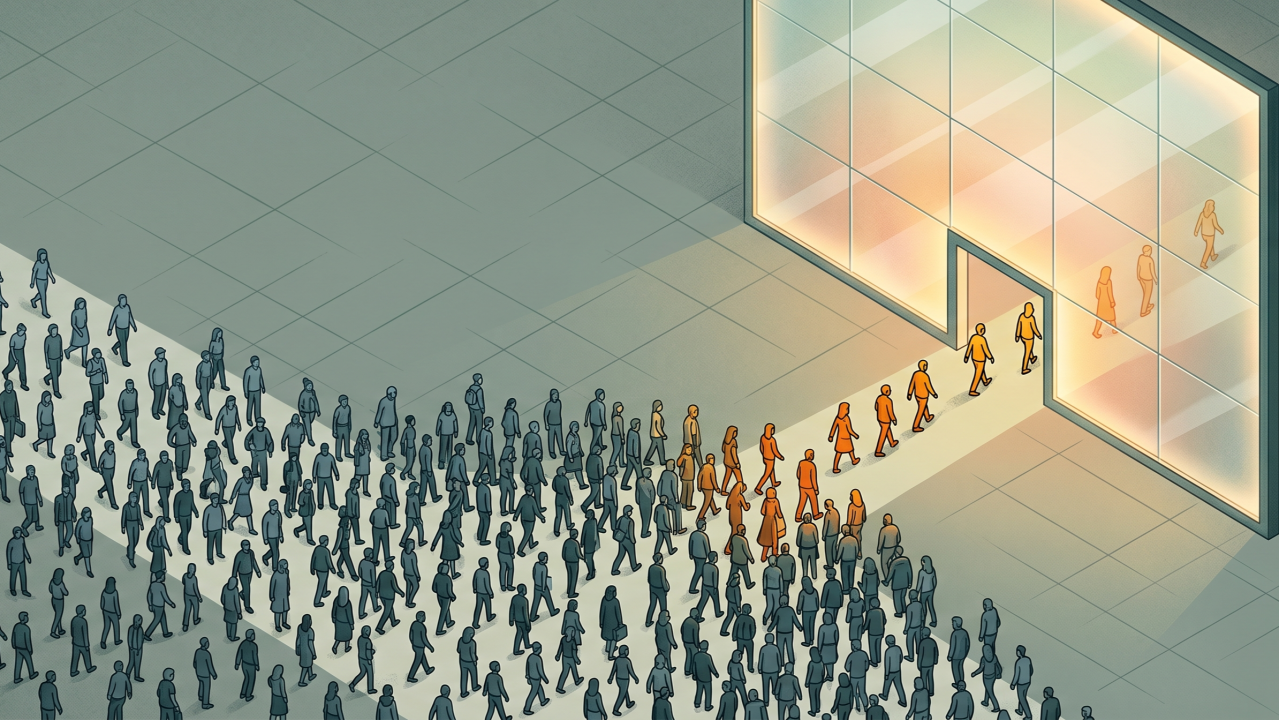
93% of searches conducted in Google's AI Mode end without a single click to an external website.
Not a typo. Ninety-three percent. That's from Seer Interactive's analysis of 25.1 million impressions. For every hundred people who search using Google's AI Mode, ninety-three of them get what they need and leave without ever visiting your site, your blog, your landing page, or your carefully optimised product page.
Google AI Mode now has 75 million daily users. And Google's CEO Sundar Pichai has said the plan is to keep migrating AI Mode features into the main search experience.
This isn't a feature update. This is a structural shift in how people discover, evaluate, and choose brands. And I'd argue most marketing teams are still optimising for a version of search that is actively disappearing.
The Click Was Always Borrowed. Now It's Being Taken Back.
Let's put this in context, because this didn't happen overnight.
Zero-click searches have been climbing for years. In 2019, roughly 50% of Google searches ended without a click. By 2026, that number has climbed to nearly 65% across all searches. But when AI Overviews are present, it jumps to 83%. And in AI Mode, as we've established, it hits 93%.
Here's what that looks like in practice: AI Overviews now appear in roughly 13% of all Google queries, up from under 5% during the 2025 limited rollout. That trajectory points to 20-25% coverage by end of 2026. Google's Q4 2025 search revenue hit $63 billion, up 17% year-on-year. Google isn't losing money from this shift. It's consolidating attention inside its own ecosystem and selling ads there instead.
And that's the part most marketers haven't fully processed. The top organic result, position one, the thing we've spent decades and billions chasing, now loses nearly a fifth of its clicks when an AI Overview sits above it. For informational queries, the kind that historically drove top-of-funnel content strategies, organic traffic has dropped 30-40%.
The ground under your content strategy didn't just shift. It opened up.
It's Not Just Google Anymore
In January 2026, OpenAI confirmed what had been whispered about for months: ads are coming to ChatGPT. By February, they were live.
Free-tier ChatGPT users in the US now see contextual ads woven into their AI conversations. OpenAI is targeting over 700 million weekly active users with this model. The pricing tells you how seriously they're taking it, $60 CPM for premium placements, significantly higher than traditional display.
Meanwhile, Gartner projects that 25% of all organic search traffic will shift to AI chatbots and voice assistants by the end of 2026. That's not speculative. That's their baseline projection, and the current data trajectory supports it.
So let me paint the full picture: Google is answering queries before users reach your site. ChatGPT is answering queries and now selling ad space inside those answers. Perplexity, Gemini, and Claude are all becoming research starting points for buyers. And the users arriving through AI platforms? They bounce 23% less and browse 12% more pages per visit than traditional organic visitors.
The people who do click through from AI are more valuable than ever. There are just dramatically fewer of them.
The Visibility Shift No One Briefed the CMO On
Here's where this becomes a strategic problem rather than just a channel problem.
62% of CMOs say they lack the skills, budget, or resources to compete with faster-moving challengers. 35% are specifically concerned their rivals are outpacing them in adapting to generative engine optimisation and zero-click search. Marketing budgets have declined to 9% of company revenue. Headcount growth has dropped 50% year on year. Training budgets sit at just 3.8% of marketing spend.
Read that back. The biggest structural shift in search since Google itself is happening right now, and most marketing organisations are being asked to navigate it with fewer people, less money, and almost no investment in building the new capabilities required.
More than 70% of marketers are prioritising short-term results over long-term growth. Not because they want to, because the pressure to prove immediate ROI leaves no room for strategic adaptation. The 2026 CMO Survey describes the highest level of marketing leader pessimism since 2020.
This is the context in which teams are being asked to completely rethink how their brand gets discovered.
The New Rules of Being Found
If the click is dying, what replaces it?
The answer is citation. Being mentioned, referenced, and surfaced inside the AI-generated answer itself.
This is a fundamentally different game from traditional SEO. Search engines used to rank web pages. AI systems synthesise answers from fragments they consider credible and assemble them into a response. Your brand doesn't need to rank first. It needs to be trusted enough to be cited.
The data here is striking. Brands cited in AI Overviews see 35% higher organic click-through rates when users do click. One AI citation can generate more qualified traffic than ranking third in traditional results. And brands with both mentions and citations in AI answers are 40% more likely to resurface across consecutive queries.
But here's the uncomfortable part for most marketing teams: third-party content gets cited by AI search three times more than company websites. University of Toronto research found that 91% of AI-generated answers cite third-party content, not brand websites. Brands are 6.5 times more likely to be cited via third-party sources like media coverage, analyst reports, and industry publications.
What does that mean? Your blog, your product pages, your content hub, the assets you control, are not where AI systems are primarily pulling credibility from. They're pulling from what others say about you. Your earned authority matters more than your owned content in this new world.
What Thinking Marketing Teams Are Doing Differently
The teams adapting fastest aren't panicking about traffic decline. They're rethinking what visibility means and building for the new discovery layer.
They're creating original data, not just content. AI systems reward authority, and authority in 2026 means being the source of data that others cite. Original research, proprietary benchmarks, surveys, and industry-specific statistics are inherently more citable than content that summarises someone else's work. 86% of marketers plan to increase research budgets in 2026. Those publishing original data report 64% higher conversion rates and 61% stronger organic performance.
They're investing in earned authority, not just owned channels. If AI pulls from third-party sources at six times the rate of brand websites, then your PR strategy, your analyst relations, your thought leadership placement in credible publications, these aren't “nice to have” anymore. They're your primary mechanism for AI visibility. The brands being cited aren't necessarily the biggest spenders. They're the most respected sources.
They're measuring citation, not just traffic. Traditional analytics capture less than half the picture in a zero-click world. Forward-thinking teams are tracking AI citation rates, share of voice in AI-generated answers, and branded search volume as leading indicators. AI visibility can decline 35% in just five weeks without active management. Quarterly audits are no longer sufficient. This requires weekly monitoring and ongoing optimisation.
They're preparing for AI as an ad channel, not just a discovery tool. Google is showing ads in 25.5% of AI Overview results, up from 3% in January 2025. That's a 394% increase in twelve months. OpenAI is building a full ad infrastructure. The brands that test these formats early will benefit from lower costs and algorithm influence before the market matures.
They're building direct audience relationships as a hedge. Newsletters, communities, first-party data, owned audiences. When every platform algorithm is in flux and AI is absorbing search traffic, the brands with direct lines to their audience are the ones with leverage. Everyone else is renting attention on ground that keeps shifting.
The Question I'd Leave You With
For twenty-five years, Google Search was the front door to the internet. Every content strategy, every SEO investment, every inbound marketing playbook was built on the assumption that if you ranked, you'd get the click. And if you got the click, you had a chance to convert.
That front door is closing. Not all the way. Not for everyone. Not overnight. But the trend is unmistakable, and the pace is accelerating.
So here's the question I'd put to every marketing leader reading this: if 93% of your potential audience never clicks through to your website, where does your brand actually live? What do they see when an AI answers their question? Are you the source being cited, or are you invisible in the answer?
If you don't know, that's the most urgent strategic gap on your desk right now. Not because AI search is coming. Because it's already here, it already has 75 million daily users, and it's already reshaping how your market finds, evaluates, and chooses.
The brands that will matter in this new world aren't the ones with the most content. They're the ones with the most authority. And authority, unlike content, cannot be produced at scale. It has to be earned.
Marketing that thinks. Not marketing that trends.
Sources: Seer Interactive AI Mode Zero-Click Study; Google Q4 2025 Earnings; Gartner (25% of organic search to shift to AI by end of 2026; Future of Marketing 2026); Ahrefs CTR data; Similarweb Zero-Click Search 2026; SparkToro / Datos historical research 2019-2025; Digital Applied (Google AI Mode, AI Overviews, Zero-Click and AI Search statistics 2026); Superlines AI Search Statistics 2026; Airops 2026 State of AI Search; University of Toronto AI citation research; Onely AI Search Visibility Guide 2026; Adobe Analytics AI referral data; CMO Survey 2026; 3Thinkrs CMO Playbook 2026; Demand Gen Report; HubSpot 2026 State of Marketing; BCG 2025 CMO Survey; OpenAI ChatGPT Ads launch (Feb 2026); Pew Research; ADWEEK 10 AI Marketing Trends for 2026.